Headless over Salesforce
A decoupled Next.js front-end on the Commerce / SCAPI APIs. Klaviyo, payments, CQuotient and your SEO equity stay; the jQuery-era SFRA layer goes.
From selling furniture to selling complete design intelligence. A headless, intelligent commerce experience, built on your Salesforce engine and reimagined for the way your clients actually decide.

Living Edge runs on enterprise Salesforce Commerce Cloud with real traffic, serious marketing, sustainability leadership and a catalogue of genuine icons. That engine is worth keeping.
But the storefront in front of it is a dated, server-rendered SFRA experience built for browsing. Your clients (architects, designers, procurement teams, discerning buyers) are making high-consideration, high-value decisions on a site that hides prices behind hover, ships a 1.7 MB bundle, carries no structured data, and shows a chair instead of the room.
We propose a headless re-front that keeps Salesforce, Klaviyo, payments and your SEO equity, then wraps them in award-grade UX, an impeccable mobile experience, ThreeJS/WebGL product immersion, and FlowNode: send a photo of your room and see any piece rendered into it, plus whole environments generated from a specification.
Every screen below is a real capture of your live site, taken during this assessment. None of it is fatal. All of it is the upside.
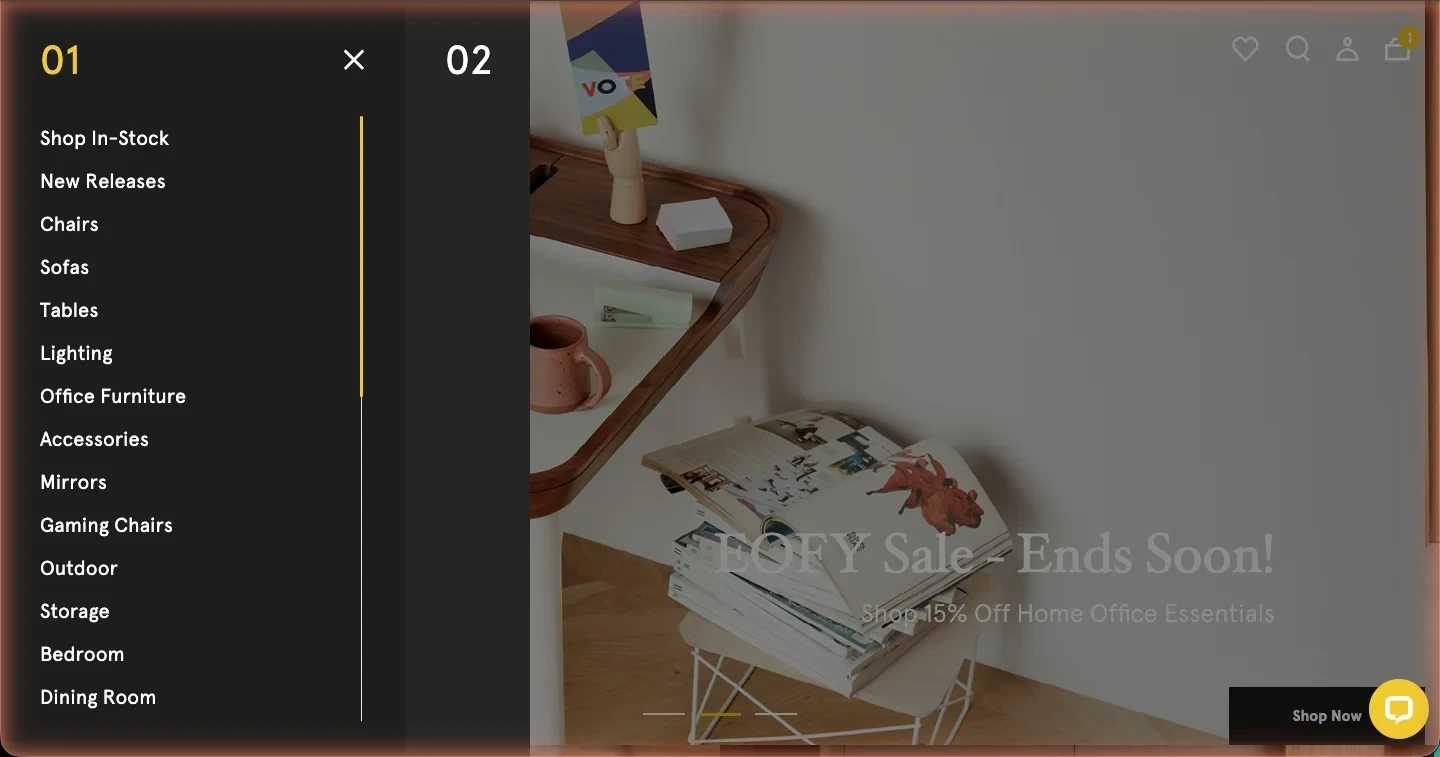
Every browse action triggers a full-screen takeover menu, a 19-item flat list that mixes Eames and Barcelona with “Gaming Chairs” and “Kids”. There is no persistent wayfinding for a deep catalogue.
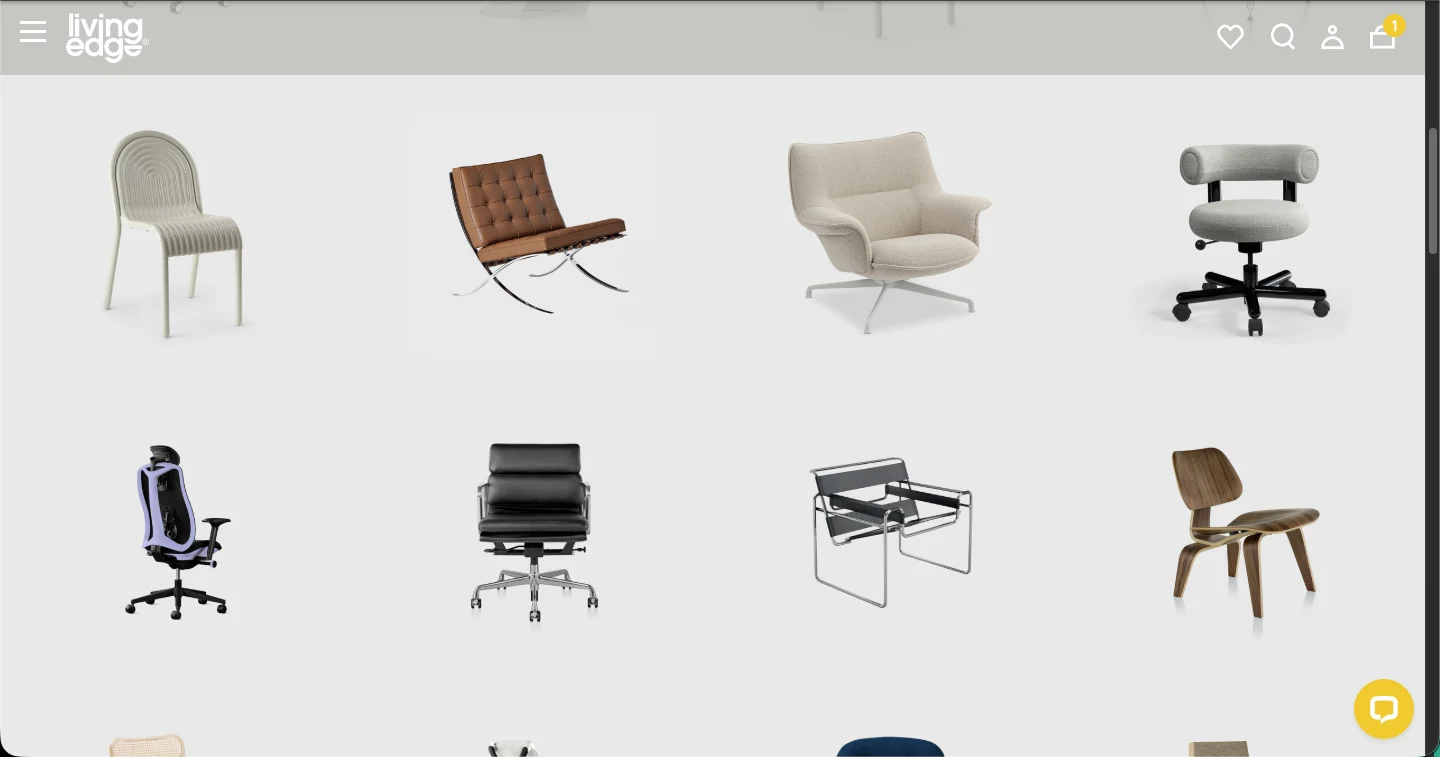
On desktop the listing is a wall of images with no names and no prices. Identity and cost stay hidden until you hover each card one at a time, so scannability and side-by-side comparison, the heart of specifying, break down.
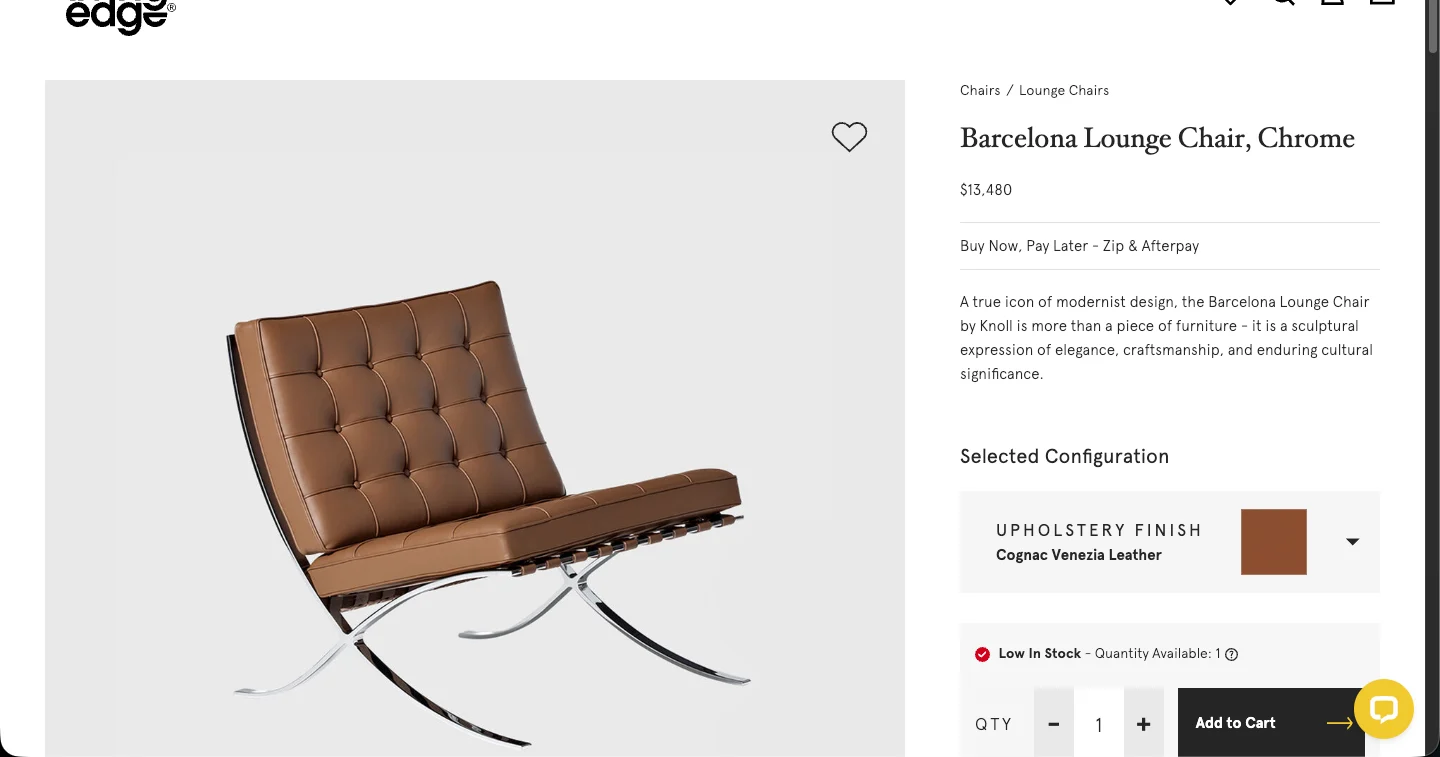
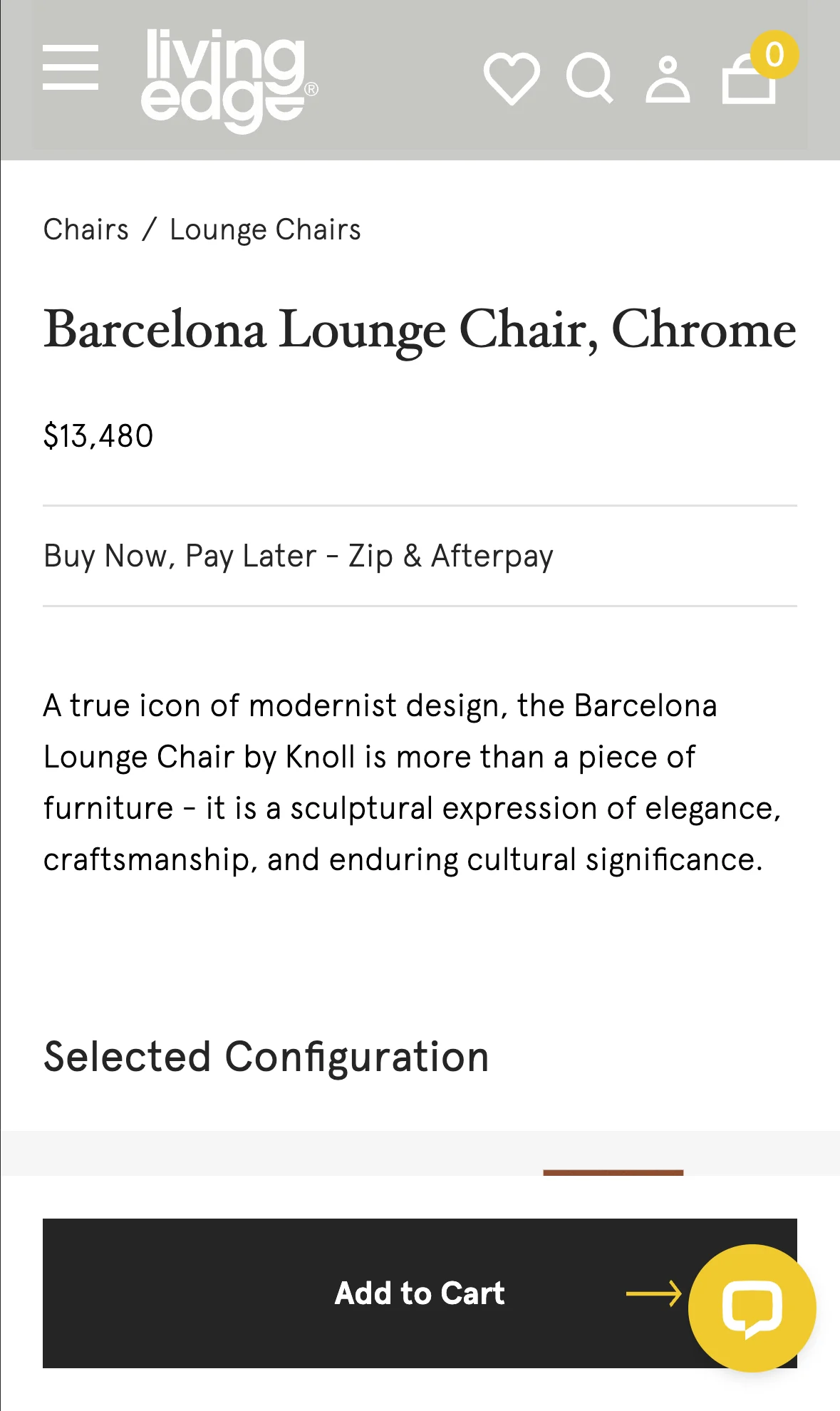
A true design icon at $13,480, presented as a static image gallery with one dropdown. No 3D, no way to see it in your room, no structured data, fixed 1600px images, and “Enquire Now” for anything complex. The highest-value moment is the least immersive.
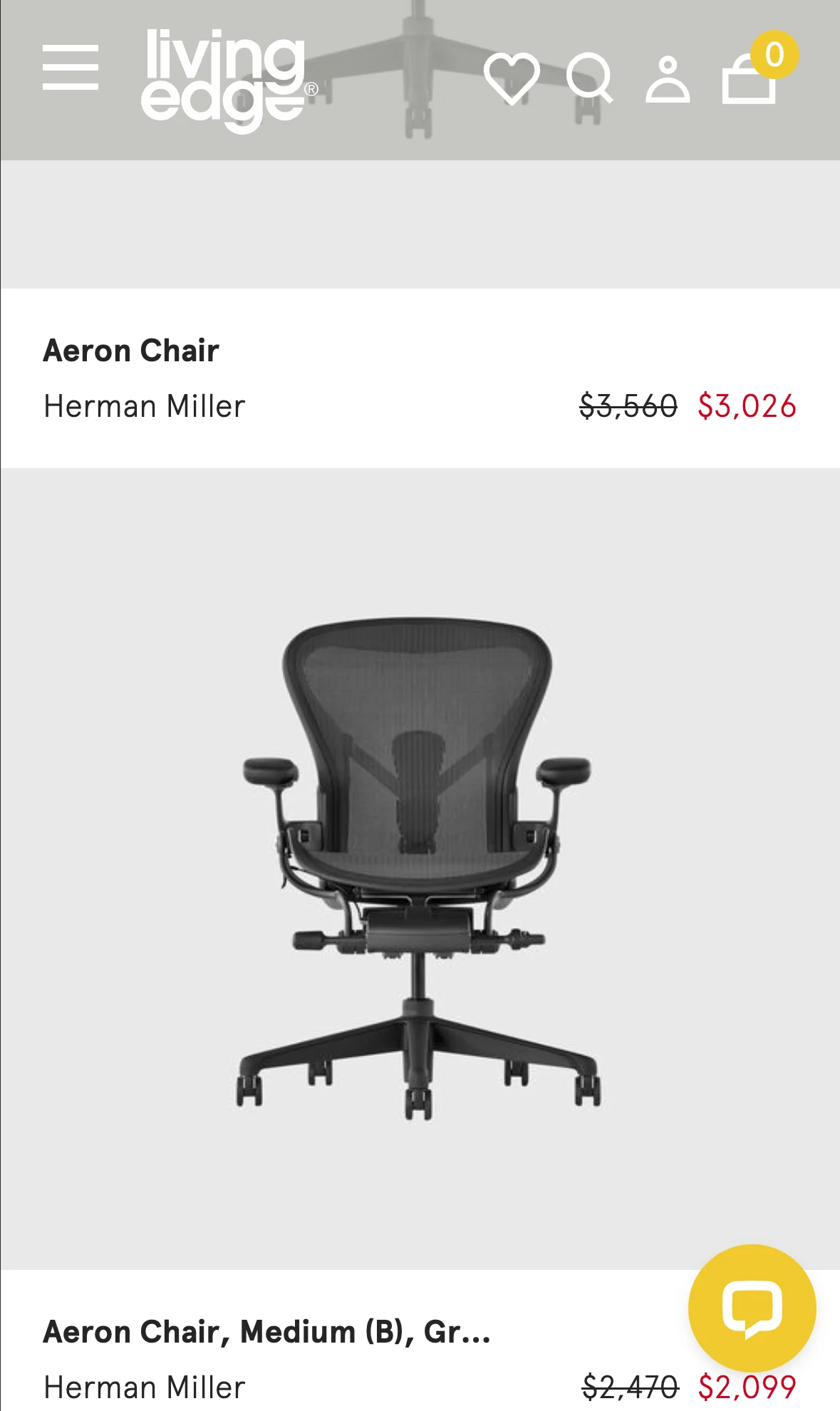
Tellingly, mobile shows the prices desktop hides, but as an endless single column with no density or quick-view. Mobile is a first-class concern for us, not an afterthought.
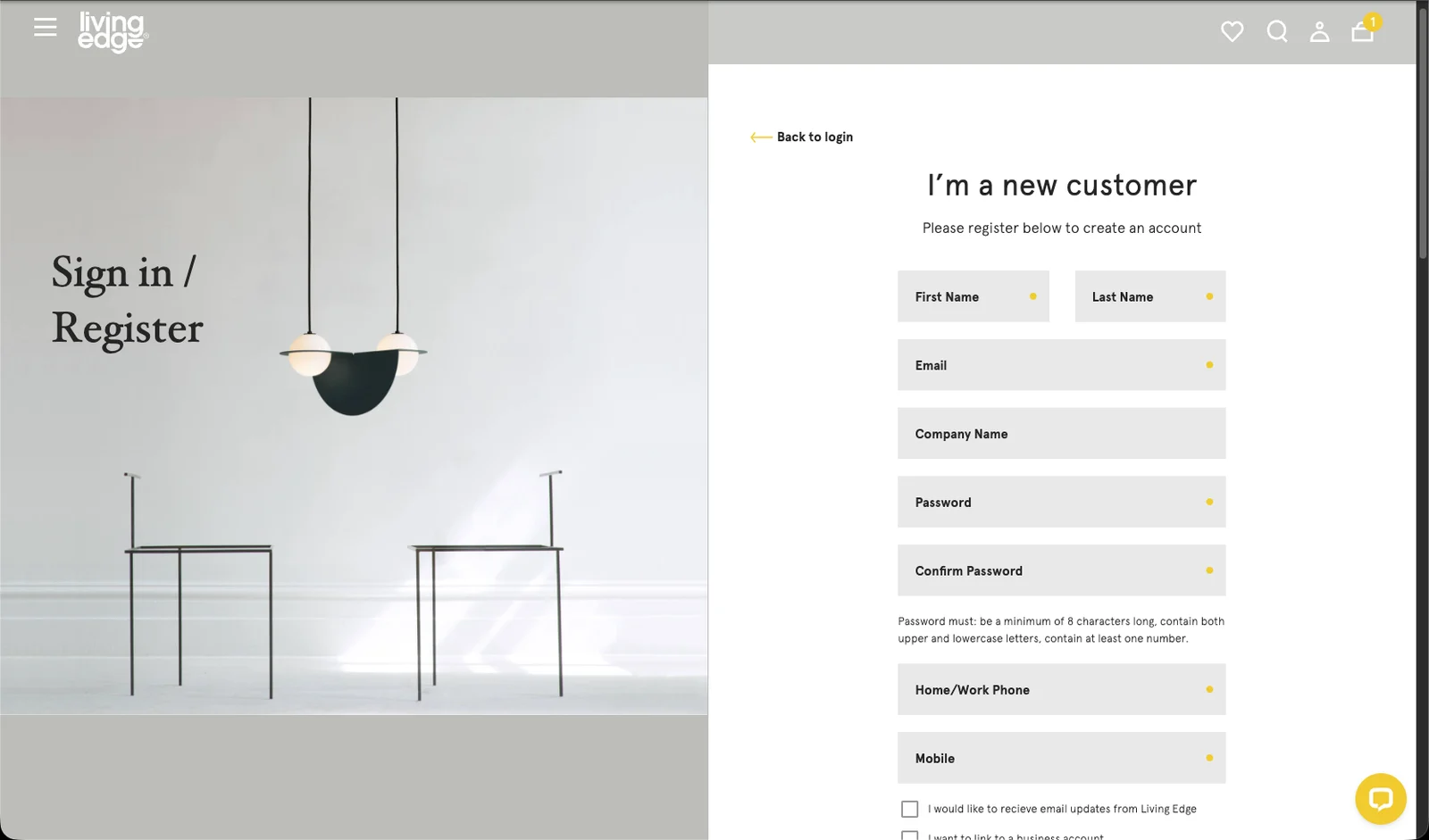
The registration form carries a live typo, “I would like to recieve email updates”, and makes two phone numbers (Home/Work and Mobile) both required. Eight fields, no social sign-on, no strength meter. Every extra field is measurable drop-off on a high-intent action.
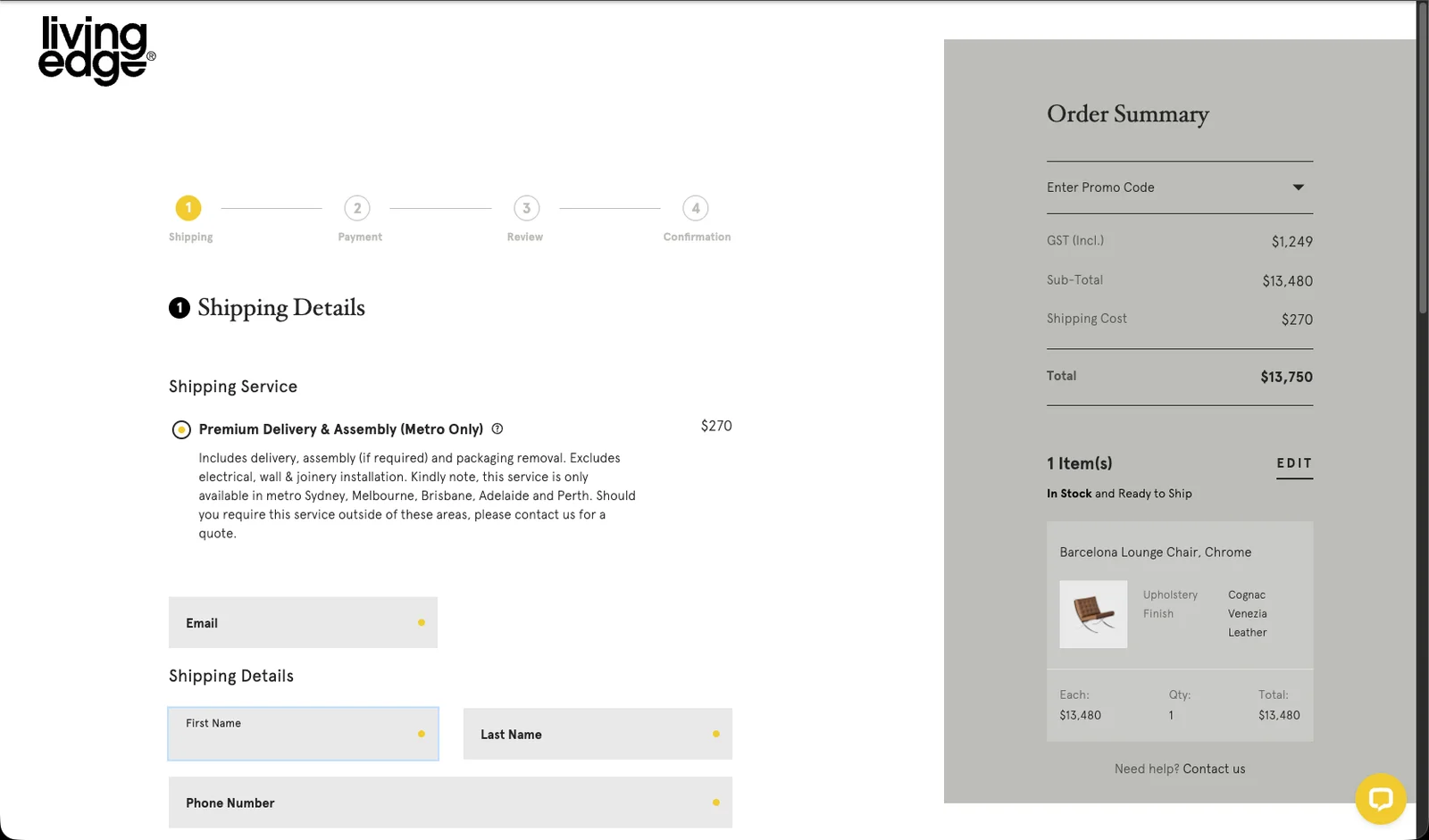
Delivery is metro-only; anyone outside the five metro cities is sent to “contact us for a quote”. The all-in total (delivery and assembly) stays hidden until this step.
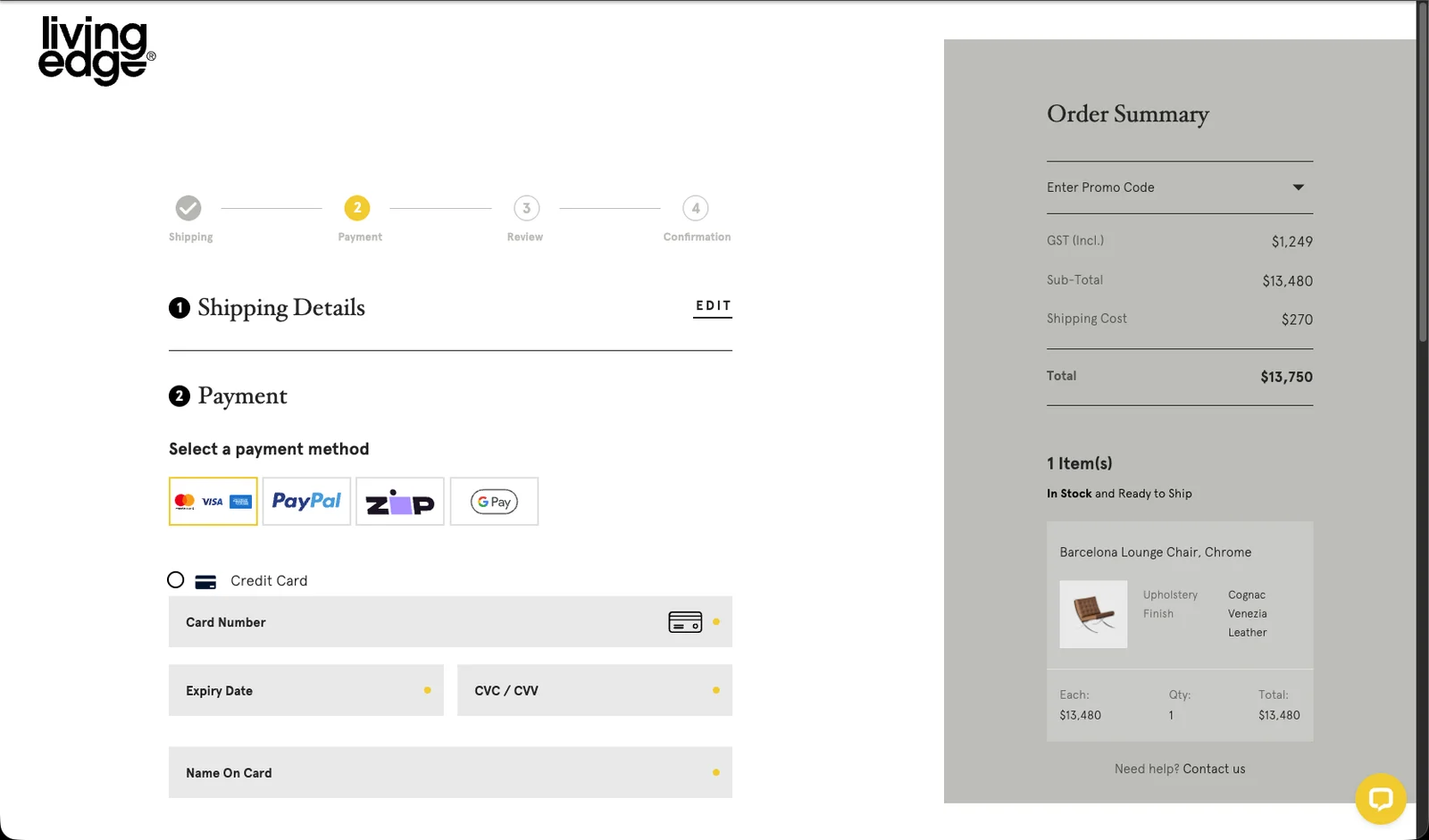
A generic card form on a five-figure order: no saved configuration, no visual reassurance of the room being bought, and nothing for the B2B specifier who needs to save a project or request a quote.
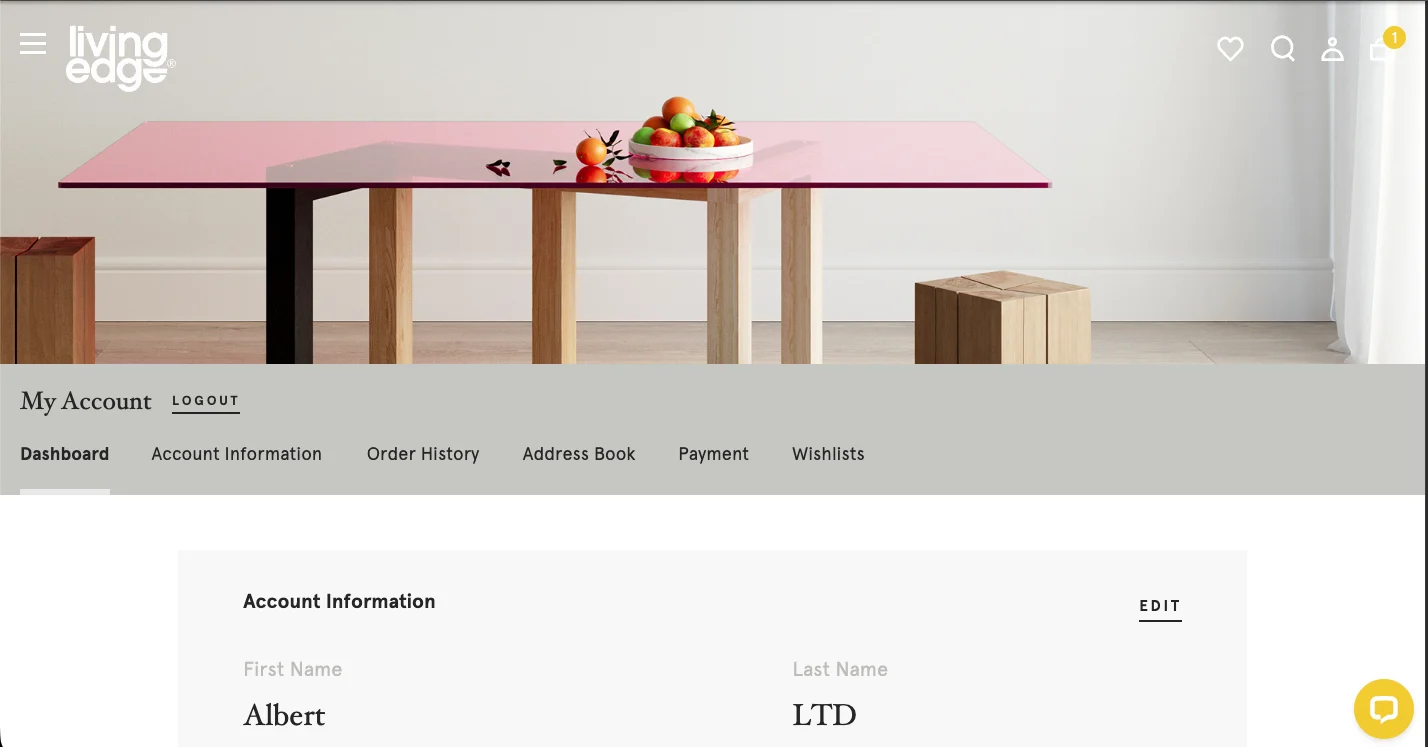
You have just created an account with a luxury brand, and this is the welcome: no greeting, no confirmation, no next step. A stock hero pushes the account below the fold, and the same six machinery tabs serve a homeowner and a trade specifier alike.
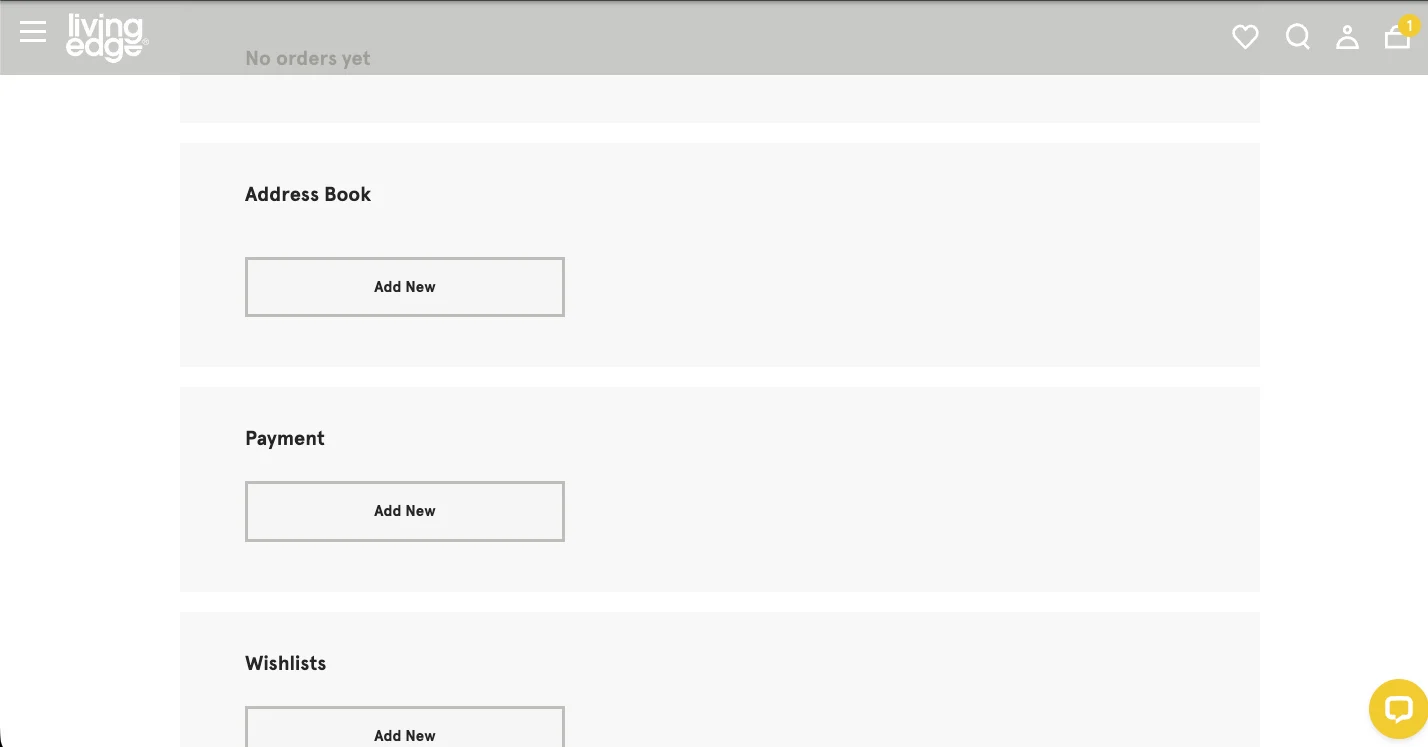
Orders, addresses, payment, wishlists: a wall of empty “Add New” boxes. Nothing suggested, nothing saved, no design services, no showroom booking, no reason to return. This is the moment a relationship should begin, and it is blank.
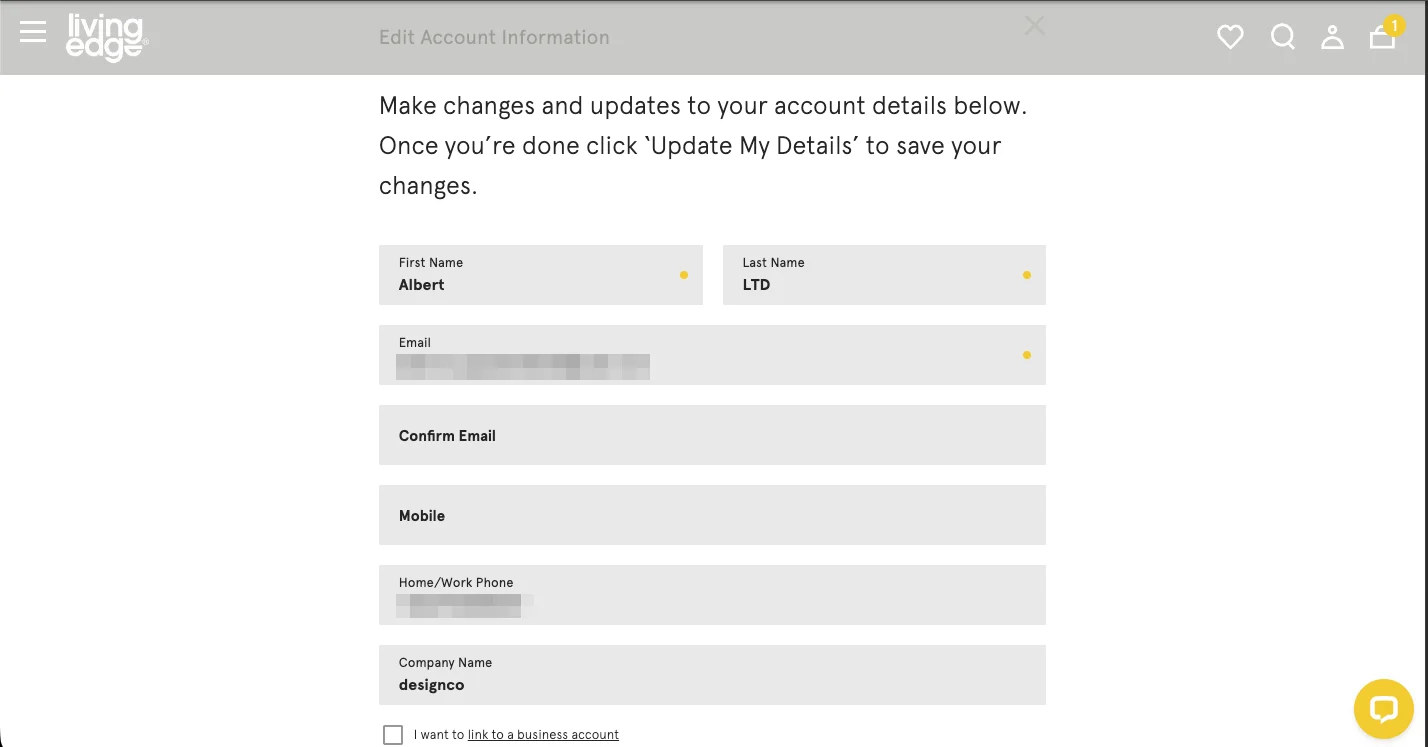
Editing your own details asks you to re-type your email into a blank “Confirm Email”, the Mobile number sign-up insisted on arrives empty, and linking a business account requires a “confirmation code”. The machinery is showing. Personal details redacted.
A full technical and email-exposure appendix (security headers, SPF/DMARC, bundle analysis) is provided separately.
We tore down the platforms you are measured against, the same week we audited yours: what they run on, what they show, what they can do. The pattern is parity, catalogue-ware on rented platforms, and an open seat at the top of the category.
Captured July 2026 · identical cold-load methodology across all sites · platforms fingerprinted from markup and resource URLs · raw data in the technical appendix.
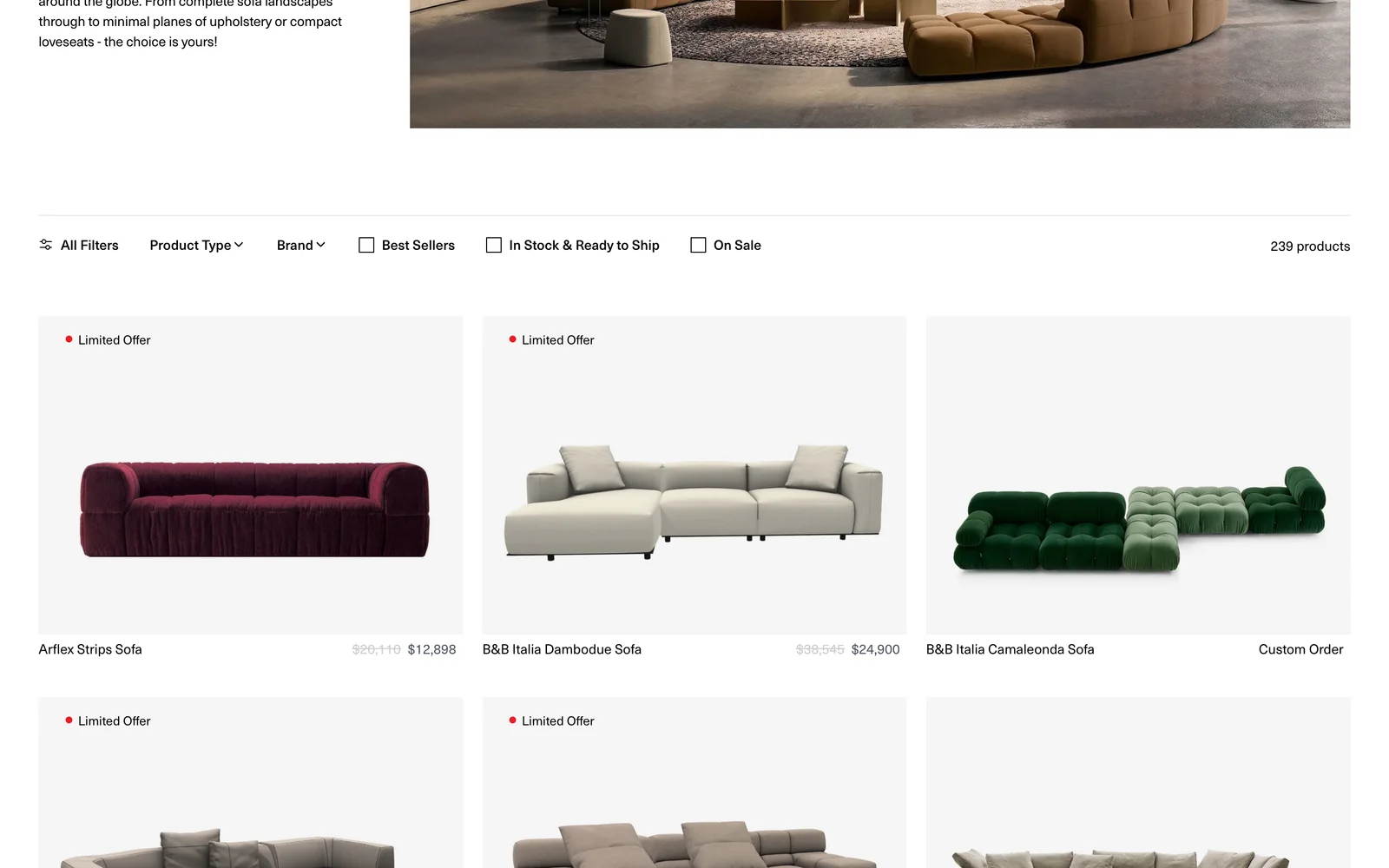
Your most direct competitor already runs a cleaner shelf: 239 sofas with brands, prices, sale tags and working filters on one listing. Better retail hygiene than livingedge.com.au today, and still nothing beyond a grid.
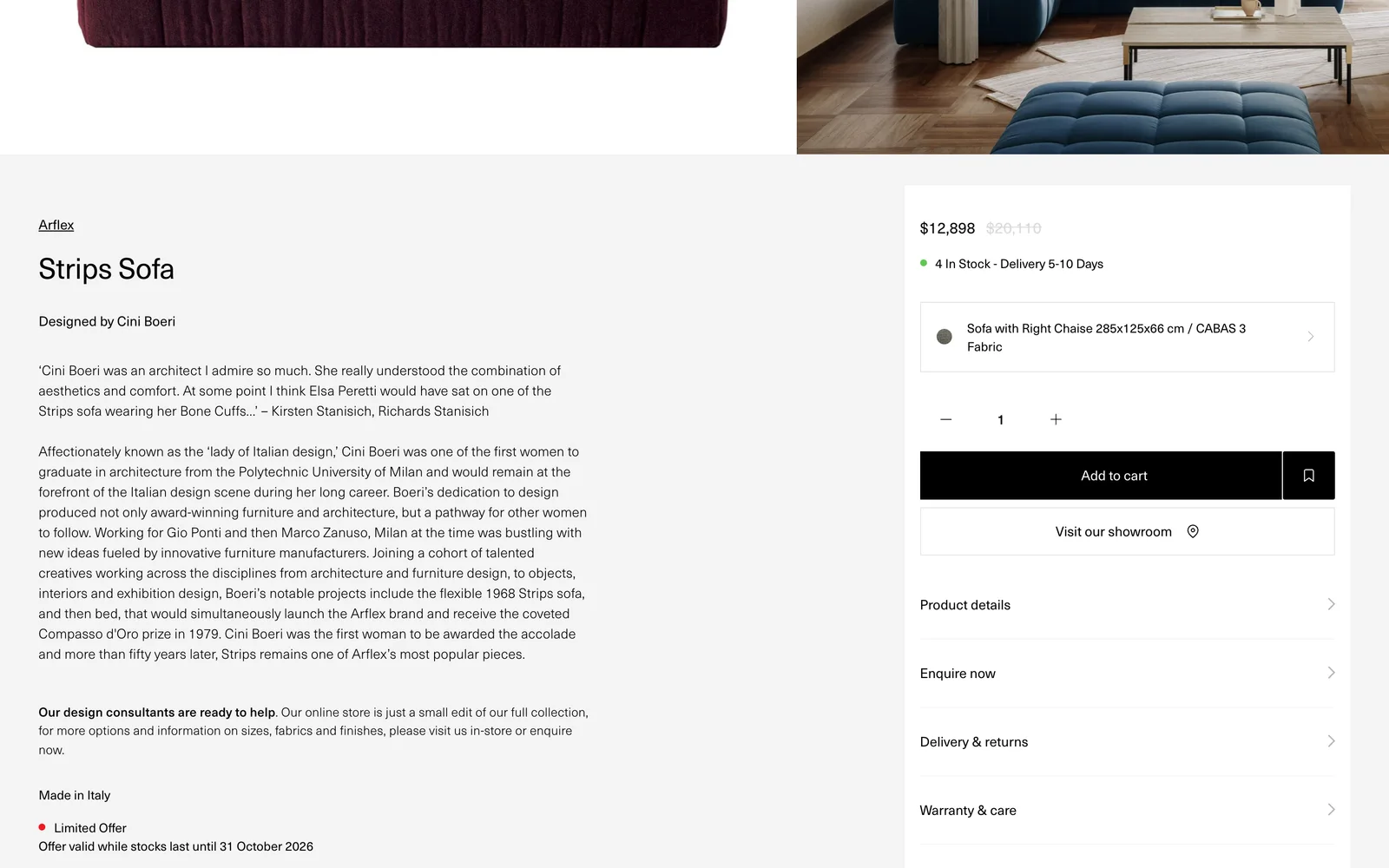
A $12,898 Cini Boeri icon, well told: editorial provenance, live stock, variants, sale pricing. And still a static template. No 3D, no in-room view; the same ceiling Living Edge hits on its $13,480 Barcelona.

Opens on a 50%-off winter sale banner: premium positioning traded for discount theatre, on an Adobe Commerce build that fires 519 requests before you scroll.
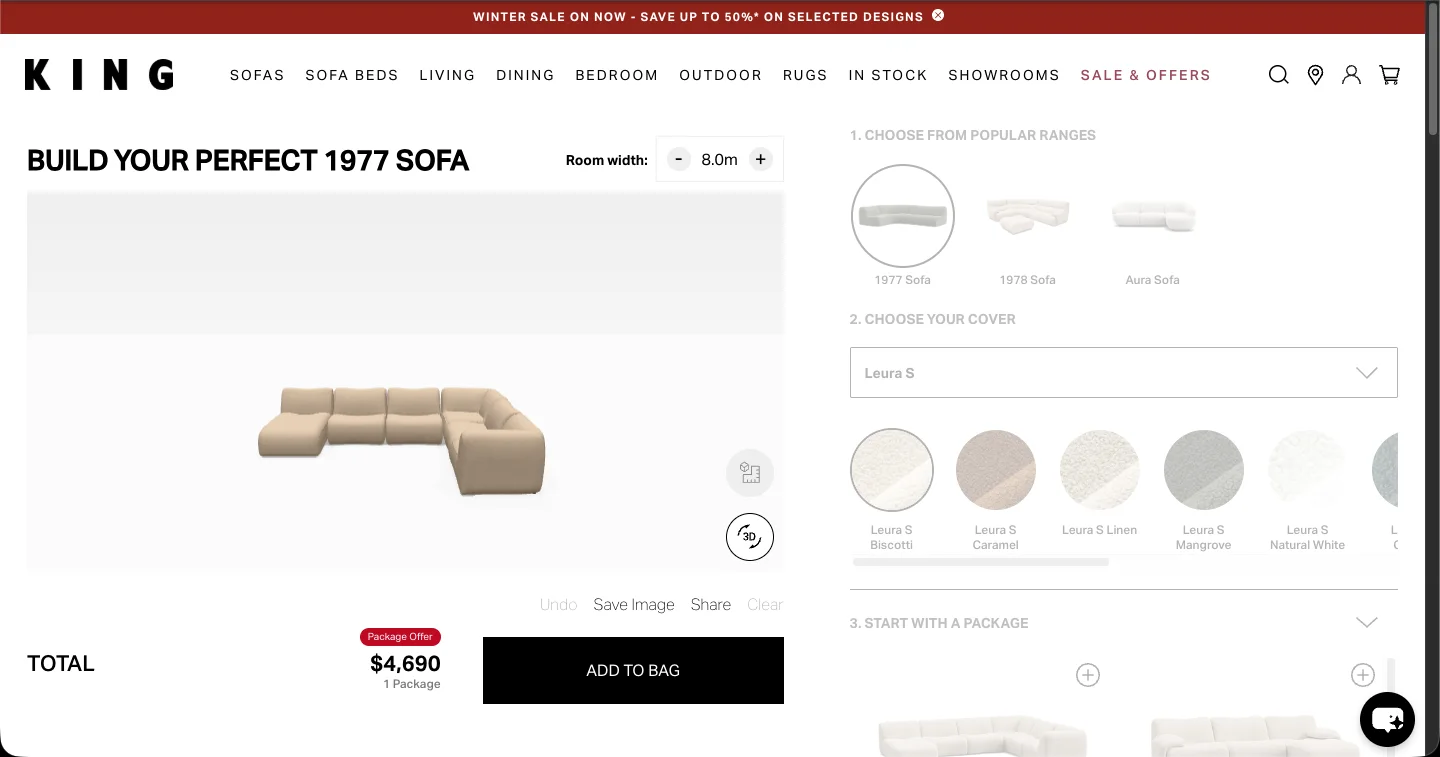
The one genuine experience feature in the field: a plan-view sofa builder with a 3D preview, here a $4,690 package. Real capability, and still a diagram in a grey void: not your room, not your light.
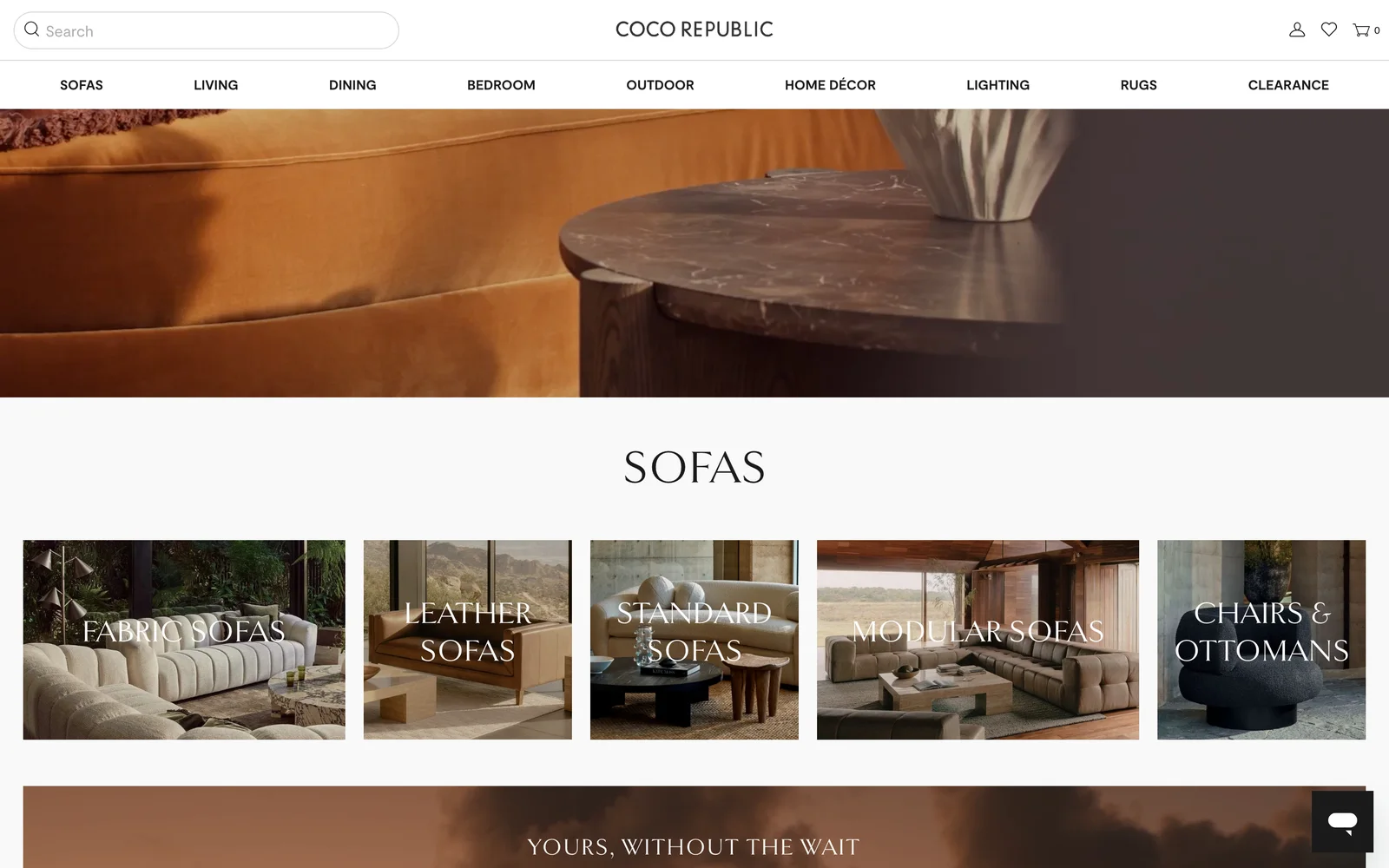
Styling-led content on BigCommerce catalogue-ware: an 18 MB homepage, visible prices, and zero product data for the machines that increasingly answer buyers’ questions.

The benchmark sells a sofa like a film: “often imitated, never duplicated”, campaign-grade art direction for one product family inside a brand universe of galleries and estates. That is the altitude this proposal targets, and even RH ships no in-room view and no AI discovery. The seat is open.
The first authentic-design retailer to sell the room instead of the grid owns the category’s next decade. Nobody in this field is building it. You can be.
Most furniture sites help people browse products. Living Edge can help clients imagine, specify, visualise, approve and buy complete environments. One workflow, five moves.
Search the full catalogue, filtered by category, brand, application, commercial rating, lead time, sustainability and budget.
Adjust finishes, fabrics, quantities and pricing scenarios against a live project, reflected instantly in the schedule and the total.
Generate room concepts built from the exact products selected, so the client sees their future environment, not a list of objects.
Layer in design rationale, sustainability insight and considered alternatives, written in the sales team’s own voice.
Produce a fully branded proposal automatically: web presentation, PDF, moodboards, schedules, cost summaries and renders. No manual decks.
We keep your Salesforce Commerce Cloud engine and replace the experience in front of it with a fast, composable Next.js storefront. Five pillars.
A decoupled Next.js front-end on the Commerce / SCAPI APIs. Klaviyo, payments, CQuotient and your SEO equity stay; the jQuery-era SFRA layer goes.
ThreeJS / WebGL product viewing, real-time configuration, fabric and finish swaps, and cinematic detail on the pieces that deserve it.
Send one photo of your room and see any product rendered into it, true to scale and light. And generate complete environments, workplace, residential or hospitality, from the specification.
Structured data on every product, clean code-split delivery, Core Web Vitals in the green, and content engineered for both Google and AI answer engines.
A mobile experience designed first, not adapted: prices, comparison and visualisation that work in the hand, on the showroom floor.
Your catalogue depth is the edge, and the tax. Not a search box, not a chatbot: a private design advisor, trained for Living Edge, that turns one sentence into a short, reasoned shortlist, and routes every shopper by who they are.
Your curated room renders here. Tap any brief above to see it happen
Plain language becomes structured intent: room, piece, scale, mood, budget, seats.
Constrained matching over your Salesforce inventory and lead times, so it never curates a piece that cannot ship.
A short, role-aware shortlist with a reason for every choice, in under two seconds, handed straight to the room visualiser.
Alongside the classic menu, never instead of it. One choice at the door tailors the catalogue, the pricing and the advisor's voice.

Room-led journeys and an advisor that speaks interiors, not SKUs, and remembers the room you are building across visits.

Trade pricing, spec sheets and lead times up front. Brief a room, get a defensible shortlist, save it to a named project.

Contract-grade collections, volume enquiry, finishes and compliance data, and a named account manager for a whole floor or venue.
Account creation is the highest-intent, highest-drop moment in the whole journey. Stripping a multi-field form down to a single verified tap removes the exact friction that loses ready buyers at the gate. We instrument it and validate the gain against your own funnel in Phase 0, so the uplift is proven, not assumed.
Upload a room photo or a magazine tear-sheet and the advisor matches the look to real Living Edge icons, then places them with FlowNode.
Paste a palette, a few words or three reference images and get a complete, coherent scheme built only from in-stock pieces.
Set a ceiling and the advisor rebalances, proposing an EVO-C or a Panton in place of a Barcelona while holding the room's character.
Assemble a multi-line project shortlist with trade pricing and live lead times, exportable as a client-ready schedule.
After a sofa ships, the advisor returns to complete the room, timed to delivery rather than a generic email cadence.
On the floor, point a phone at a piece and the advisor recalls the saved project and shows what pairs with it in stock.
Three very different people walk through the same door: someone furnishing a home they can already feel, a designer on a client’s deadline, and an architect fitting out a whole building. Today the site meets them all the same cold way. The new platform recognises each one, and reshapes around them.
Lands with a feeling and a room in mind, half unsure a place selling A$13,000 chairs is even for them.
Greets them warmly, opens the At Home path so the site reframes around rooms and living, and shows prices from the first glance, an invitation rather than a wall.
Lands mid-project, often deep-linked to a piece, already in spec mode and short on time.
Role-based navigation lets them enter as trade once and be remembered. Trade pricing, lead times and spec sheets surface by default, no quote request, no hover-to-reveal.
Arrives mid-project from a spec or a recommendation, needing to know in seconds this is serious contract work.
Role-based navigation opens an Architecture & Contract world: contract collections, project credentials and a clear route to a named account manager front and centre.
Prices and lead times visible up front, never behind hover or a quote request.
A home, a practice or a building: choose once, and everything reframes.
Showroom host, sounding board or specification partner, depending on who is asking.
Saved rooms, named projects and records persist across every visit.
Send one photo of the corner it will live in: an office, a lobby, a living room. FlowNode renders the exact product into your photo, at true scale, in your light. Tap to watch it render into the space:

 Workplace
 Living
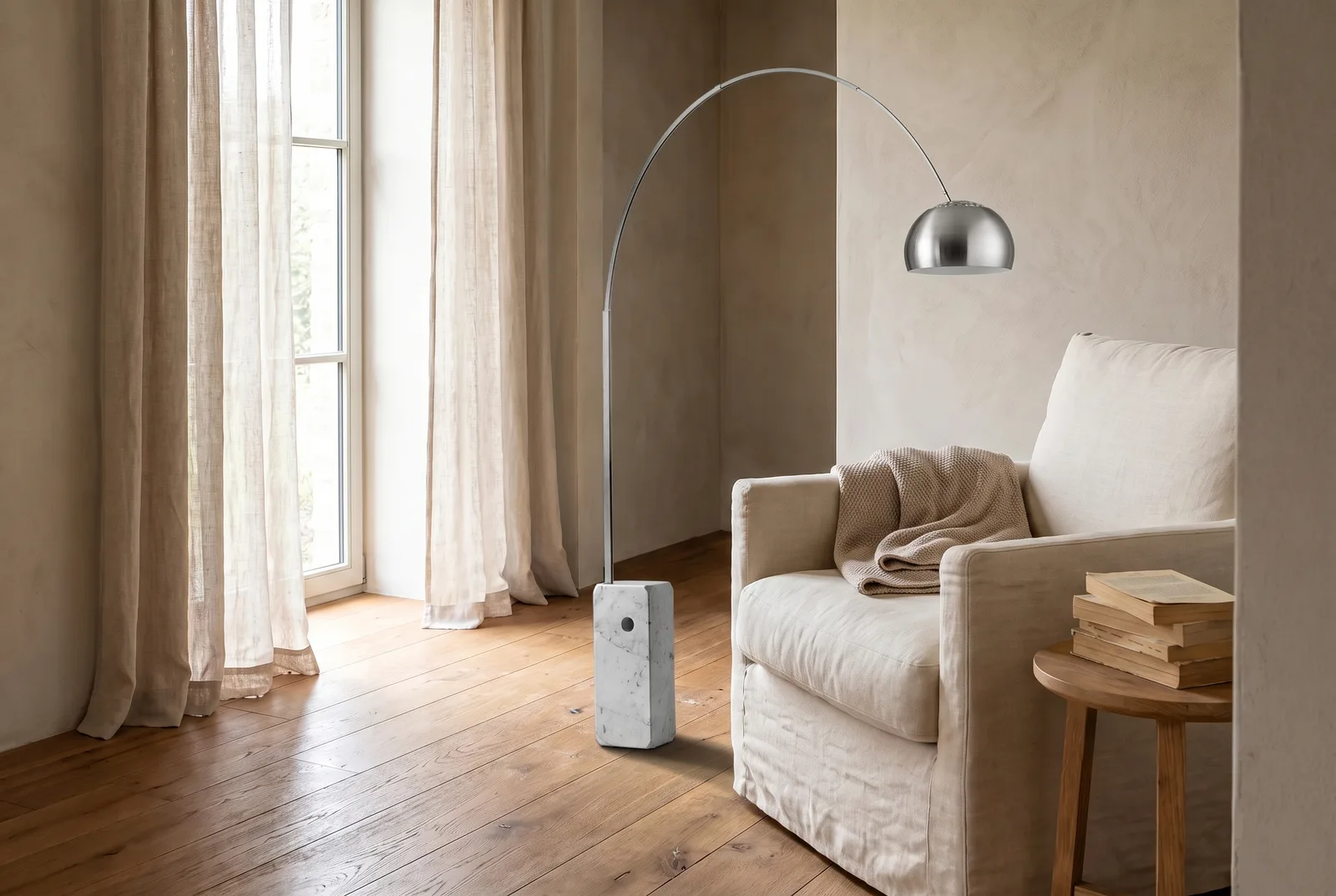 Reading nook
 How it works. No app to install, no camera gymnastics: the client uploads a photo of their room and FlowNode renders the piece into it, photoreal and true to catalogue scale. Because it works from photography rather than 3D models, it covers the whole catalogue from day one. Every placement here uses a real Living Edge product, rendered by FlowNode.
And every collection becomes an environment, generated for workplace, residential and hospitality, furnished with the actual range, not stock photography.



The product page becomes an experience: real-time ThreeJS / WebGL viewing, 360° rotation, material and fabric swaps, and zoom that holds up on a $13,000 icon.

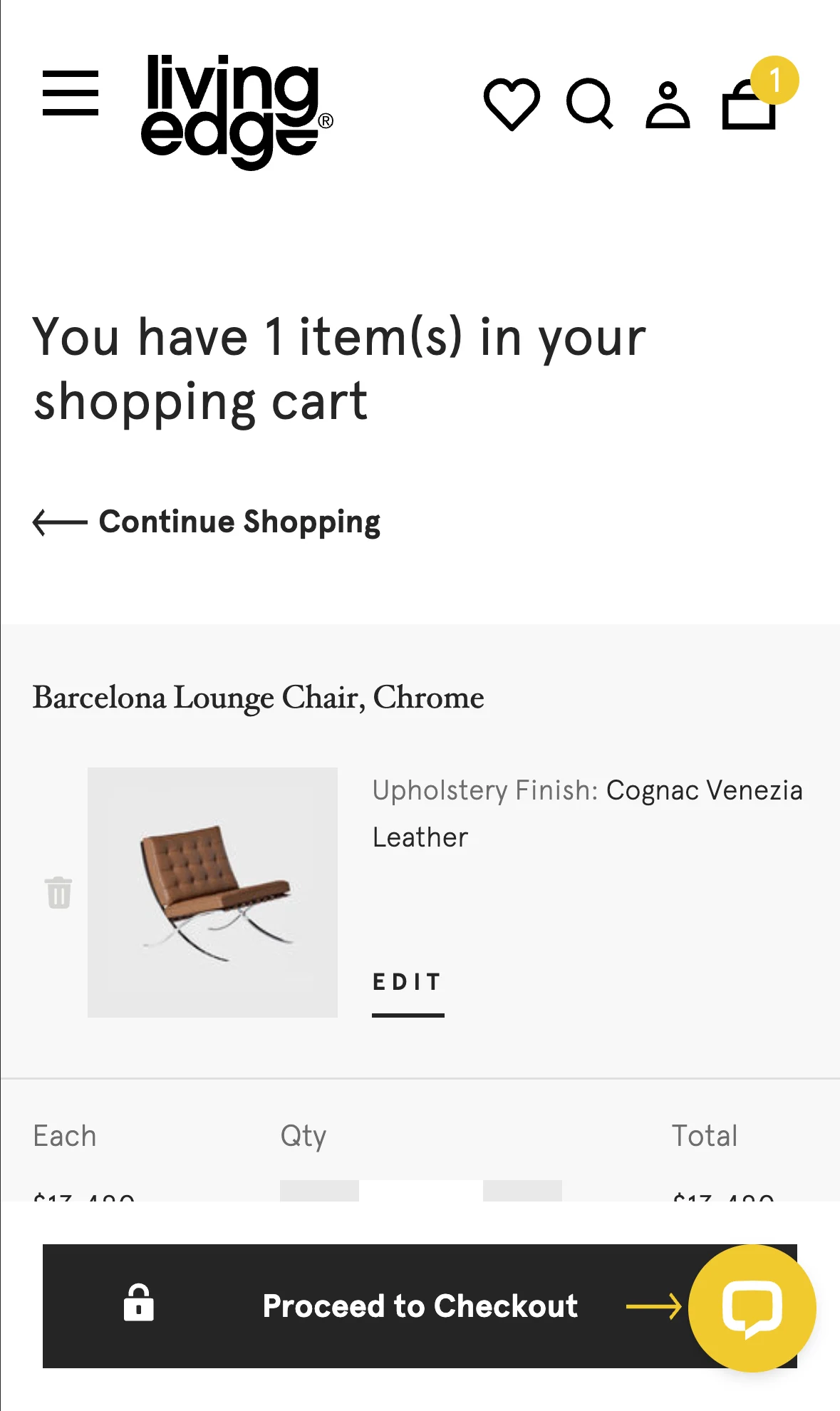
We walked your entire mobile flow, the way most of your clients actually arrive. Every screen is a real capture of the live site, home to cart, shown the way it deserves to be seen.
A composable, headless front-end on your existing Salesforce Commerce Cloud APIs. Nothing of value is thrown away; the dated presentation layer is.
Three paths trace the system end to end, the way a single tap actually moves through it.
A natural-language brief is parsed into a typed schema, embedded and retrieved over the live catalogue, ranked by persona, gated against real stock, then reasoned into a grounded shortlist streamed in under two seconds. The model vendor stays hidden behind the gateway.
From the PDP the shopper uploads a photo of their room. The BFF enqueues a FlowNode render job; the engine pulls the product master from the DAM, composites the piece into the photo at true catalogue scale and light, and publishes the finished scene through the asset CDN back to the client to reveal.
A guest basket is mutated through the BFF and SCAPI, identity is brokered through SLAS into httpOnly cookies, and payment is captured inside PSP-hosted fields the front-end never sees. SFCC authorises, then emits order events that revalidate cache and reach Klaviyo, keeping the front-end in PCI SAQ-A scope.
The detail behind the diagram. Eight workstreams, every one a real engineering commitment.
Salesforce B2C Commerce Cloud is retained as the transactional engine: product master, price books and promotions, Omnichannel Inventory for ATS and lead-time, the basket-to-order lifecycle, customer profiles, and CQuotient / Einstein. We remove only the dated SFRA storefront cartridge. Every commerce decision keeps executing inside SFCC, so Business Manager merchandising and existing ERP and OMS integrations work unchanged. This makes the programme a presentation replacement, not a re-platform, the single biggest risk reducer in the proposal.
All traffic terminates first at Cloudflare (DNS, TLS 1.3, WAF, Bot Management, Turnstile, DDoS). Only scored-clean traffic reaches Vercel over an mTLS origin pull, so the rendering tier is never exposed directly. Next.js renders each surface with the cheapest correct strategy: ISR with stale-while-revalidate for PLP and PDP, SSR for cart and account, and the Edge Runtime for personalisation. Partial Prerendering streams a static shell instantly and fills dynamic holes via Suspense, which drives the Core Web Vitals gain over the current monolithic bundle.
The Next.js app never calls SFCC directly. A Backend-for-Frontend exposing a GraphQL / RPC schema is the only commerce contract the UI knows. A typed adapter wraps SCAPI and OCAPI with retries, backoff and a circuit breaker, so an SFCC slowdown degrades gracefully instead of cascading. The BFF composes SFCC, the DAM, the advisor and Einstein into a single shaped response per view, which keeps pages fast and the client code thin.
Shopper identity runs through SLAS using OAuth2 with PKCE. A server-side token broker holds guest and registered JWTs in httpOnly, SameSite cookies with silent refresh; the browser holds only an opaque session reference. Payments use PSP-hosted fields and the native payment sheet for Apple Pay, Google Pay, PayPal and Zip. The card PAN is captured inside the PSP iframe and tokenised; only a network token reaches SFCC. The new front-end never sees cardholder data, keeping it in PCI-DSS SAQ-A scope rather than the far heavier SAQ-D. A board-level reassurance point.
Freshness comes from events, not polling. SFCC jobs and webhooks emit price, inventory, catalogue and order changes; an HMAC-verified receiver translates them into precise cache operations: Redis tag invalidation plus on-demand ISR revalidation of exactly the affected routes. A catalogue sync pipeline fans the same deltas out to three consumers: it upserts embeddings into the advisor vector index, publishes a structured product feed for SEO and AI answer engines, and keeps Klaviyo current. Live availability and final totals are always fetched fresh at request time.
The advisor never runs free text straight into retrieval. The utterance plus any prior brief is sent to the advisor model under a constrained schema, extracting a typed brief validated against Zod. A hybrid retriever fuses vector and keyword hits with hard metadata filters; a cross-encoder re-ranks by persona and affinity; a hard stock gate calls back to SCAPI so nothing out of stock survives. Only in-stock candidates and their real catalogue facts reach the grounded reasoner, whose output is citation-bound and guardrailed. The brief persists across turns, and the whole gateway is budgeted and traced to hold the response under two seconds. Every model call routes through an internal gateway that abstracts the vendor.
The 3D PDP is a hydration-gated island streaming Draco / KTX2 assets from the DAM through progressive LOD. On "see it in your room", the client uploads a photo of their space; the BFF enqueues an async job that the FlowNode render service fulfils, compositing the product into the customer's own photo at true catalogue scale and light, then publishing the photoreal scene to the CDN. Because placement works from photography rather than per-product 3D models, it covers the entire catalogue from day one. The DAM is the single source of truth for both 3D and imagery.
The app emits typed JSON-LD, OpenGraph, sitemaps and a clean structured feed so AI answer engines ground on accurate Living Edge inventory rather than hallucinating, protecting the SEO equity accrued under SFRA. Real-user monitoring captures INP, LCP and CLS; consent-gated analytics flow into GA4 and Klaviyo alongside server-side events. Server renders, BFF calls, advisor latency and grounding, and FlowNode jobs are all traced with OpenTelemetry into Datadog and Sentry. A regression is observable in production rather than discovered by the customer.
Every decision in this platform points at one outcome: more of the right visitors becoming buyers, and Living Edge becoming the experience every other furniture brand is measured against.
Sub-second, code-split pages in place of a 1.7 MB bundle. Faster sites convert more and rank higher, full stop.
Placing the exact piece in the client's own space collapses hesitation on high-consideration, high-value purchases.
Structured data and AI-discoverability put Living Edge in Google rich results and AI answer engines, capturing demand competitors never see.
Visible prices, fewer fields, transparent totals, saved projects. Every drop-off point from the audit, removed.
The majority of discovery is already on mobile. A mobile-first experience converts the traffic you are already paying to attract.
RH and Aman don't sell products. They sell a world worth belonging to. This is the platform that lets Living Edge do the same, and lead the category while doing it.
Figures are published industry benchmarks, indicative of direction and validated against your own analytics in Phase 0.
Each phase ships something real. You are never waiting twelve months for a big-bang launch.
Audit, data model, design system, technical foundations and the visual language.
The composable Next.js front-end live over Salesforce: home, catalogue, PDP, cart, checkout, mobile, SEO.
ThreeJS product experience on the hero ranges, and FlowNode photo-based “see it in your room” across the catalogue.
Generative environment renders and the automated, branded proposal engine.
SLA support, monitoring, Core Web Vitals and a quarterly optimisation roadmap.
Indicative; phases overlap. Total program is roughly 9 to 12 months, with the headless storefront live around month five.
A fixed-scope program, phased so spend tracks delivered value. Commercials are intentionally open at this stage: every figure is marked TBD and will be agreed together before contract.
Phases can be contracted independently. P1 alone delivers a live, modern storefront.
Year one, all-in: build + 12 months of running costs · TBD, finalised together in the definitive offer
FlowNode credits are usage-based and hosting scales with traffic. Salesforce licensing is unchanged and billed by Salesforce. SEO & AI SEO optimization (ranking in search engines and in AI answers: ChatGPT, Perplexity, Gemini) is an optional add-on, priced separately.
Desmoz Digital leads design, engineering and delivery: one Athens-based team, senior people only, one line of accountability from the first workshop to years after launch.
The studio behind the platform: product design, headless engineering, FlowNode and the AI advisor, with program delivery and care under the same roof. The seniors who design it are the people who build it, a boutique practice that takes on a limited number of programs at a time.
The advisor you tried in section 05 is not a concept. We designed and shipped the same describe-it-and-we-curate-it intelligence, with role-based navigation, for Costa Navarino, a flagship Mediterranean luxury resort destination.
P1 by itself ships a live storefront. Continue, pause or stop at every gate.
Code, repositories, design files and data belong to Living Edge from day one. Documented handover, no lock-in.
A presentation replacement, not a re-platform. Salesforce keeps trading, and cutover stays reversible until launch.
Phase 0 baselines your funnel. Every claimed uplift is validated against your own analytics, reviewed quarterly.
References and a live walkthrough of the shipped advisor are available on request.
Not a better website. A new category: design intelligence as a service, on your Salesforce engine, delivered by Desmoz Digital.
Ninety minutes with your team: the audit, this platform, your questions answered live.
Four to six weeks: funnel baselines, the data model, and the design language, on your real catalogue.
Around month five the new experience takes over, with immersion and intelligence following behind it.